Wednesday, 31 March 2010

LPG Cylinder expiry date

Here is another mail going rounds in the internet. The text of the mail goes like this:

Have u ever heard about LPG cylinder's expiry date.

How to find LPG cylinder's expiry date? Very important information. Do you know that there is an expiry date (physical life) for LPG Cylinders? Here is how we can check the expiry of LPG cylinders:

On one of three side stems of the cylinder, the expiry date is coded alpha numerically as follows A or B or C or D and some two digit number following this e.g. D06. The alphabets stand for quarters -A for March (First Qtr) B for June (Second Qtr) C for Sept (Third Qtr) D for December (Fourth Qtr). The digits stand for the year till it is valid. Hence D06 would mean December qtr of 2006. Share this message with everyone you know, Ur kind cooperation will save life of many people and create awareness among the public. Please do not accept the cylinder if the date has already expired.


Mail Status: False

Correct information:
This is not cylinder's expiry date, these digits stand for the year when the cylinder is due for statutory testing. Details are given below:

On one of three vertical stay plates (side stems) of the LPG cylinder, the date is coded alpha numerically as A or B or C or D and a two-digit number following this e.g. D06. The alphabets stand for quarters - A for Qtr. ending March (First Qtr), B - Qtr. ending June (Second Qtr), C-Qtr. ending Sept (Third Qtr), & D for Qtr. ending December (Fourth Qtr). The digits stand for the year when the cylinder is due for Statutory testing as explained above. Hence D06 would mean that the particular cylinder is to be taken for the next Statutory Testing by December 2006.

In any case, this is not the date of EXPIRY of PHYSICAL LIFE of the CYLINDER .

It is further clarified that, during service, every empty LPG cylinder when it comes from the Distributor to the Bottling Plant for filling, is checked for its condition including the marked date for Statutory Testing due. Cylinders due for testing are segregated and sent for testing. Every cylinder after its filling with LPG is checked for correctness of its weight and soundness, before despatch to the Distributors. Every care is taken to ensure that cylinders which are safe for use are only sent to our Distributors for further distribution. It means if a customer gets a cylinder in June 2006 with marking as B06, it does not indicate that the physical life of the cylinder has expired. It only means that this cylinder is due for Statutory testing by end June 2006.


Source: Indian Oil Corporation website
Tuesday, 23 February 2010

Yet another display of Sycophancy by Congress!

President in her address to parliament on 22nd Feb 2010, has announced a new scheme of rural LPG distribution namely "Rajiv Gandhi Gramin LPG Vitarak Yojana". Yet another scheme under the banner of "Nehru family" (read Nehru, Indira Gandhi, and Rajiv Gandhi)! Yet another display of Sycophancy by Congress government!

Tuesday, 16 February 2010

Electronics City Elevated Expressway

As my office base re-shifted to Electronics City, I got the chance to use newly constructed elevated expressway which was opened for public recently. I've driven between silk board and e-city for more than 1 year and I've seen the pain. It was a horrible 10km drive with traffic jam, loads of dust because of express way construction, mindless driving by almost all types of vehicles, senseless honking and the list goes on. So, it was obvious that every motorist like me was desperately waiting for this express way (Yeah, am not sure if I'm going to use it once toll fee is introduced!).

With all those excitement and joy, I drove my vehicle on express way and wow, it was a non-stop, consistent at 70KMPH drive over a stretch of approx. 9.5kms! I was in E-city in 10mins from silk board (I used to take 35mins to more than 1 hour before). I really enjoyed the drive.

Not sure how many people are going to use this when toll fee is introduced. Again, it depends on how much we have to pay for one way. A word of caution though, ensure you have enough fuel in your vehicle before you hit the express way. Otherwise, you have to tow your vehicle to either side of 9.5KM stretch! By the way, my colleague has already experienced it!

Wednesday, 20 January 2010

Have you really seen Arundathi?!

In Hindu marriage, one of the customs is to see Arundathi star. Here, husband has to show the star to his wife. Why is this custom? Some says this is to test how sharp the bride's eyes are! Well, this can be applied to groom also. Others says this is a symbolic method to describe the story of Arundathi. Whatever the reason is, typically what happens is, this custom happens in a day light. Symbolically, priest asks husband to look at the sky and the husband yells to his wife "There is Arundati star"! In day time, It is very difficult to see Venus, the brightest object in the sky after Sun and the Moon, forget about the Arundathi star. So, actually husband and wife does not see the star. I'm sure you might have come across this situation!

Well, I'm going to tell you how you can locate Arundathi star. Before I jump into that, let me explain you a bit on Arundathi and the star.

As per purana, Arundathi is wife of sage Vasishta. And Vasishta is considered to be one of the sapta rishis (The Seven Great Sages). Now, let's look at these from Astronomy.

Often people relate Pleiades to Sapta rishis. This is wrong. Pleiades is a open star cluster and in Hindu Astronomy, it is referred to as Krittika nakshatra. Sapta Rishis are identified by modern astronomers as Big Dipper. This is a pattern of seven stars which is visible throughout the year in most parts of the Northern hemisphere. Big Dipper is situated in Ursa Major constellation. One side of the Big Dipper looks like a bowl and the other side as handle.

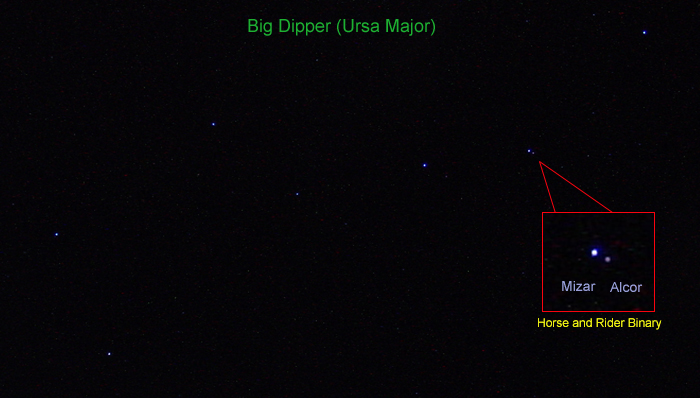
From the handle, the second star is called Mizar. In Hindu astronomy, it is Vasishta. Now, you can guess where you can find Arundathi! Yes, a faint star visible nearer to Vasishta is Arundathi star! In modern astronomy, it is called, Alcor. It's apparent magnitude is +3.99. In Astronomy, that means, if you can see this star in a naked eye, your eye sight is really good!

Now, let me show you the picture so that you can identify this in the sky. Of course, if you cannot locate this star, this could also be because of light pollution in your city!


Image Credit: Wikimedia (Click this link if you cannot see the above image properly)

(My point of reference is Bengaluru). Go out after 10.30PM IST, face yourself to North-East direction. Observe carefully, you can see the pattern of stars similar to the one shown above. Once you have located it, check if you can see Arundathi! Of course, let me know your (eye test) result! (By posting a comment)

Note: If you are still wondering how to locate this in your city, take the help of Sky Chart. Enter the co-ordinates of your city and use the sky map!

Friday, 1 January 2010

Greetings

Wish you a happy, prosperous and successful New Year 2010!

Wednesday, 16 December 2009

Bhakta Prahlada and Saint Erasmus of Formiae

My cousin who is working as a Pilot sent a mail to our family group explaining about St. Elmo’s fire. St. Elmo’s fire is a weather phenomenon that often appears on the masts of ships and the wings of airplanes. That was informative and we got to know about it.

I got curious on the name “St. Elmo” and did a quick googling and got to know that St. Elmo was named after Saint Erasmus of Formiae and he is venerated as the patron saint of sailors.

After digging more about this saint, I got this interesting tale about the saint. The summary of this tale is somewhat similar to our “Bhakta Prahlada” story. Read on…

According to his legend, when the persecutions of the Emperor Diocletian began, "Erasmus was called before a judge, beaten around the head, spat upon and 'besprinkled [...] with foulness.' He was then beaten with leaden mauls until his veins broke and burst. Erasmus suffered all of these punishments with tremendous willingness. Erasmus was then thrown into a pit of snakes and worms, and boiling oil and sulfur were poured on him but 'he lay therein as he had lain in cold water, thanking and loving God.' Then thunder and lightning came and electrocuted everyone around save Erasmus. Thus the saint was protected from the lightning. Diocletian had him thrown in another pit, but an angel came and slew all the vipers and worms."

Then came the Western Roman Emperor Maximian who, according to Voragine, was "much worse than was Diocletian." Erasmus would not cease preaching the Gospel, even though he was "put into a pan seething with rosin, pitch, brimstone lead, and oil, [which were] pour[ed] ... into his mouth, [from] ... which he never shrinked." A searing hot cloak and metal coat were both tried on him, to no effect, and an angel eventually carried him away to safety."
"And when this holy man came before the false gods" - to which he was to be forced to sacrifice, they "fell down and broke all in pieces, and consumed into ashes or dust." That made the emperor so angry he had Erasmus enclosed in a barrel full of protruding spikes, and the barrel was rolled down a hill. But an angel healed him. Further tortures ensued:
His teeth were ... plucked out of his head with iron pincers. And after that they bound him to a pillar and carded his skin with iron cards, and then they roasted him upon a gridiron...and did smite sharp nails of iron in his fingers, and after, they put out his eyes of his head with their fingers, and after that they laid this holy bishop upon the ground naked and stretched him with strong withes bound to horses about his blessed neck, arms, and legs, so that all his veins and sinews that he had in his body burst."
The version of the "Golden Legend" did not relate how Erasmus fled to Mount Lebanon and survived on what ravens brought him to eat, an interesting pre-Christian mytheme. When he was recaptured, he was brought before the emperor and beaten and whipped, then coated with pitch and set alight (as Christians had been in Nero's games), and still he survived. Thrown into prison with the intention of letting him die of starvation, St Erasmus managed to escape.

Tuesday, 1 December 2009

Just an update!

It's been a bit long time since I peeked into my blog. I was very busy at work and didn't get time to blog! However, I continued my micro-blogging via twitter!

I've a couple of things to blog such as my memorable bike ride to Mysore during Dasara festival, my first ever visit to cricket stadium for an international match, and an interesting story on Saint Erasmus of Formiae and how it is similar to our "Bhakta Prahlada" story.

I hope to spend some time to blog. So, keep watching! Till then, have a good day!